
FUSION ENERGY
The unlimited power that fusion reactors generate could become the core of the earth’s energy future. Unlike nuclear power plants based on the fission of uranium which must be mined and enriched, fusion uses abundant fuel and has a better environmental footprint. But, there are major hurdles to bulding viable fusion reactors.
RadiaBeam is developing innovations that overcome a significant hurdle.
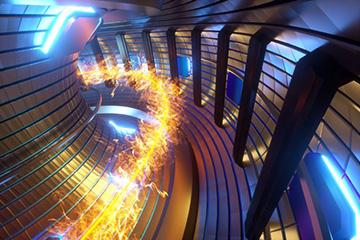
Our plasma-facing tiles made with 3-D printing may be one small part of the fusion energy picture, but they solve a big problem and cover vast areas. The surfaces in diverters confining a typical plasma volume of 100 cubic meters. That’s a lot of tile, all made in America with RadiaBeam technology.
CHALLENGE:
Reduce cost and complexity of fusion reactors that run hotter than the sun
The plasma-facing components (PFC) of the tokamak in fusion reactors must withstand temperatures up to 100 million degrees C, many times hotter than the sun’s core. The surface of diverters gets eroded by the speed, heat and flux of particles, causing downtime. Installation and ongoing maintenance are complex, costly, short-lived and unsustainable.
OUR FUSION SOLUTION:
Pave diverters with “tile” based on the construct of the soccer ball
RadiaBeam’s innovation replaces what is now a bulky, cumbersome and costlyexpensive milled layer covering extensive interior surfaces. Ouring process with 3-D printed “W” (plasma-ready) tungsten parts incorporateing lattice-like geometries for cooling. As per the skin of a soccer ball, our modular components fit together as tiles to conform to any chamber configuration. Cooling is optimized at a precision level. Existing chambers can be easily retrofitted, and if tiles fail, modules can be quickly replaced as needed. The result: longevity and reduced maintenance cost.
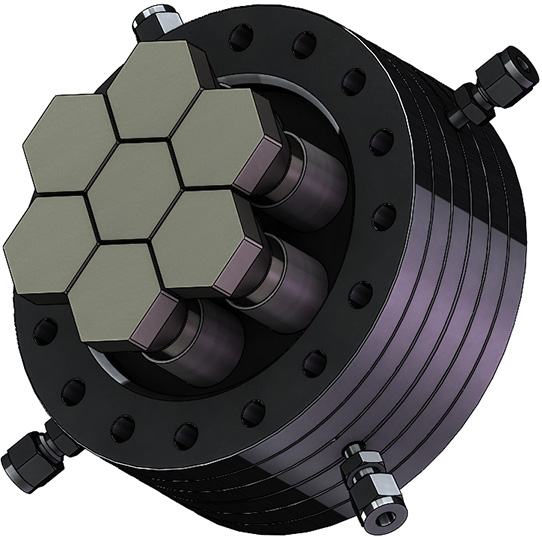
MODULAR COMPONENTS WITH COMPLEX GEOMETRIES,
MADE SIMPLE WITH ADDITIVE MANUFACTURING
By applying innovations in component design and additive manufacturing, RadiaBeam has developed a simple and modular solution to what is now a complex, slow, expensive and rigid fabrication and maintenance process, one of the factors that has held back the progress of fusion energy.
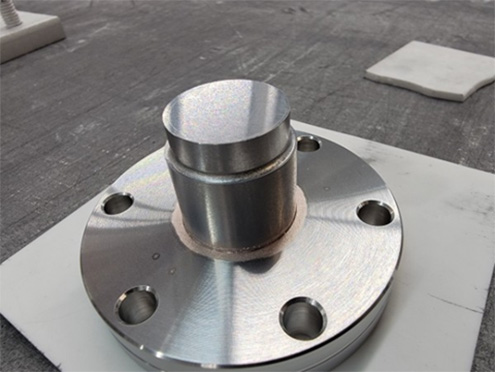
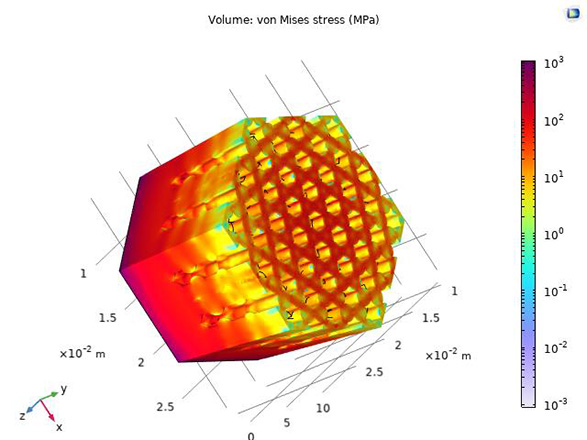
Bring on the heat and particle fluxes
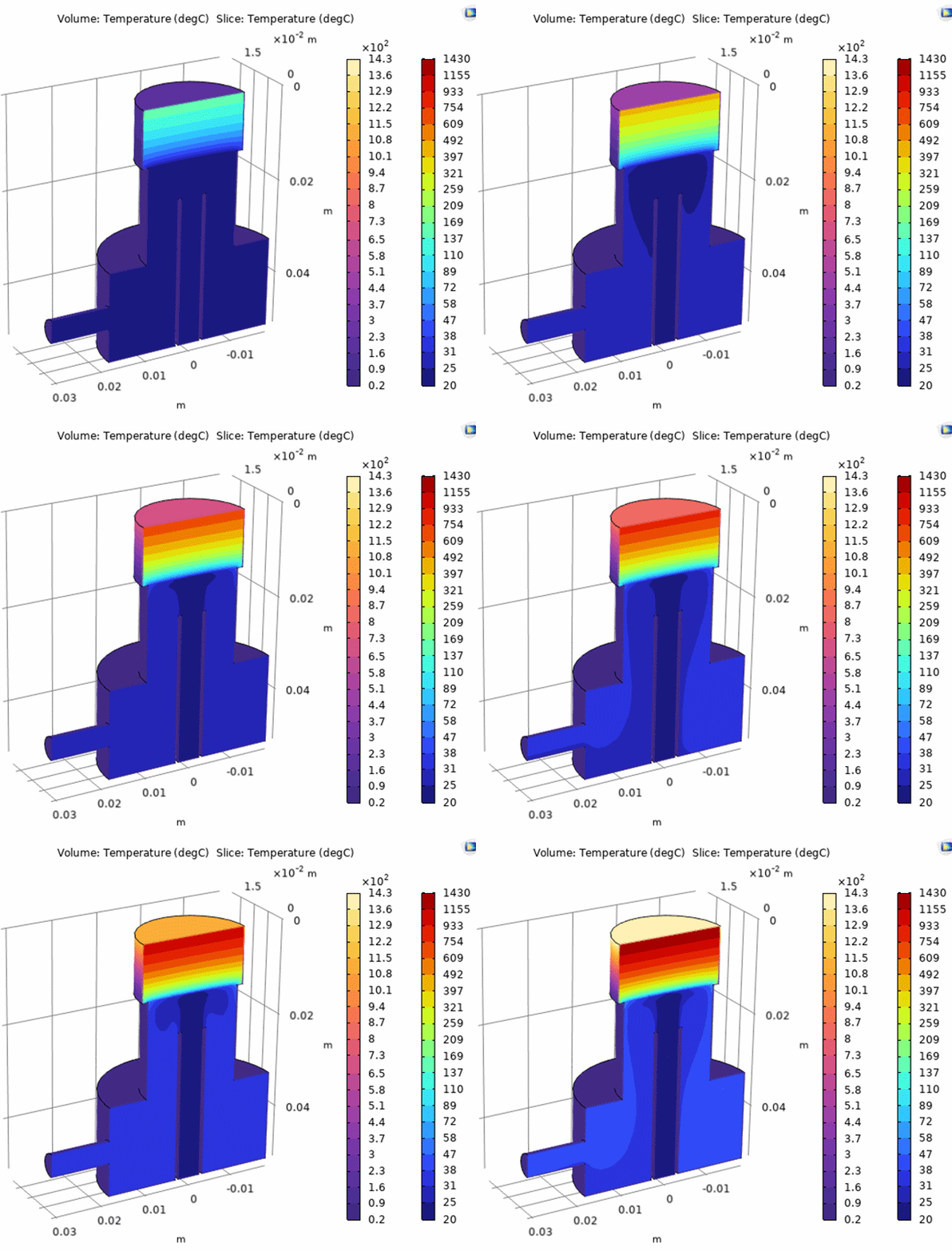
We simplify production while improving performance under extreme heat and particle fluxes. RadiaBeam 3-D printed tungsten components have integrated features and lattices specifically designed to enhance thermal compliance, reduce manufacturing complexity, and support Helium-Cooled Modular Jet (HEMJ) divertor systems.
HIGH FIDELITY TESTING THAT REPLICATES FUSION CONDITIONS
This development of next-generation PFC’s (Plasma-facing components) for fusion reactors is an advanced research collaboration supported by Government Grant DE-SC0021700, RadiabBeam, and collaborators with national research institutions.
The true test
RadiaBeam is scrupulous about testing and validating our innovations at every stage. For example, to ensure real-world readiness, materials developed through this initiative are being tested in plasma-material interaction environments that replicate fusion conditions. High-density deuterium plasma generated by a helicon source is magnetcally confined and directed toward tungsten targets, enabling rigorous evaluation of erosion resistance, thermal fatigue, and plasma-induced surface modification.